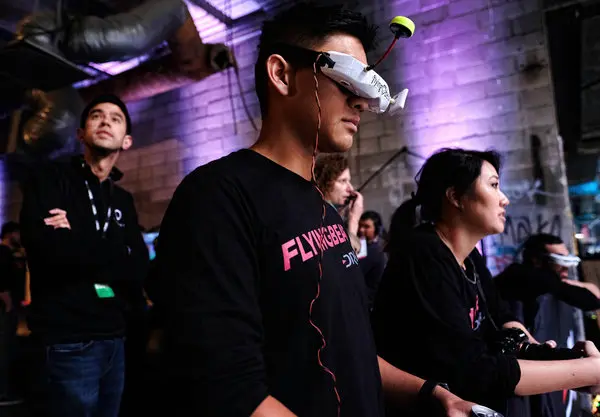
The question of whether virtual or real drone racing proves more intense reveals a nuanced reality: they represent fundamentally different experiences that cannot be directly compared on simple intensity scales. Modern FPV simulators have achieved 94-99.9% physics accuracy to real flight, enabling skill transfer that rivals traditional motorsports simulator-to-track transitions. However, real drone racing introduces psychological, physical, and environmental variables that simulators deliberately abstract away, creating intensity dimensions entirely absent from virtual competition. The answer depends on how one defines “intensity”—technological accuracy versus psychological pressure, or physical consequence versus mental exertion.
Technological Realism: Simulators Have Nearly Closed the Gap
Modern FPV simulators—VelociDrone, Liftoff, DRL Simulator, and others—employ advanced physics engines replicating real-world flight dynamics with extraordinary precision. The accuracy is genuinely impressive: these systems model prop wash effects during tight turns, battery voltage sag under variable load, altitude-dependent air density (reducing lift by approximately 12% at 100-meter altitude), and rotor vortex dynamics predicting component stress during impacts.
Critically, this technical sophistication enables direct skill transfer. DRL SIM users who excel in virtual tournaments have earned professional pilot contracts ($75,000-$100,000+ annually), and their real-world racing success validates the simulator’s fidelity. Jacob “Jawz” Schneider famously won DRL SIM esports tournaments, then won the official DRL 2017 Tryouts, and subsequently secured professional racing victories in the physical league—demonstrating that simulator excellence can produce legitimate professional pilots.
However, simulators deliberately abstract certain variables. Wind patterns, RF interference, equipment malfunctions, sensor drift, and prop wash effects that vary based on altitude and atmospheric conditions remain partially or completely unmodeled. One experienced pilot described the critical distinction: “Simulators are the ideal conditions. In real life, there’s a LOT of factors. Wind, snowy feed, RSSI to transmitter, fog, prop wash.”
Psychological Intensity: The Missing Dimension
Where simulators fundamentally diverge from real racing lies in psychological pressure—the intangible element that separates training from competition. Simulator racing carries zero financial consequences. Crashes damage nothing; pilots reset instantly and retry identical attempts infinite times. This consequence-free environment accelerates learning dramatically, but it also eliminates the psychological stakes that define genuine racing intensity.
Real drone racing introduces multiple pressure vectors absent from simulation. DRL professional pilots compete for $75,000-$250,000+ prize pools, with rankings publicly visible and sponsorship opportunities contingent on consistent performance. Every race carries measurable career consequences. A pilot finishing second instead of first loses visibility and sponsorship potential—consequences that motivate intensity beyond what any gamified simulator leaderboard achieves.
The physical consequences amplify psychological pressure further. A crash in real racing potentially damages a drone worth $300-800, requiring expensive repairs or replacement. This financial consequence creates what researchers term “risk awareness stress”—a persistent cognitive burden where pilots simultaneously execute high-speed maneuvers while maintaining awareness that single errors create tangible losses.
Research from cognitive psychology validates these distinctions. Studies measuring electroencephalography (EEG) brain activity during simulator practice versus real competition show markedly different neurological signatures. Simulator practice produces decreasing alpha and beta band power with repetition, indicating reduced arousal and stress—the learning curve actually reduces mental strain as pilots habituate to task demands. Real racing maintains elevated cortisol (stress hormone) and higher heart rate variability throughout competition, indicating sustained psychological pressure that never habituates.
Environmental Realism: The Variables Simulators Cannot Capture
While simulator physics accuracy approaches 95%+, physical environments diverge dramatically. Real drone racing venues introduce unpredictable variables that fundamentally alter flying experience.
Wind represents perhaps the most significant environmental factor. Real wind doesn’t blow steadily; it gusts unpredictably at 30-50 cm/s or higher, creating thrust variations of 20-50% depending on drone mass and orientation. Simulators generally offer binary “wind on/off” toggles rather than dynamic gust simulation. A pilot practicing on simulator with wind enabled might encounter uniform 15 cm/s crosswind, while real racing introduces sudden 40 cm/s gusts requiring dynamic throttle compensation.
Prop wash—downwash turbulence from drone propellers—creates extraordinarily complex aerodynamic effects that even advanced simulators struggle replicating. When drones pass through their own preceding wake, propellers encounter reverse-flow air, creating efficiency loss and thrust oscillation. This phenomenon varies dramatically based on altitude, propeller configuration, and preceding maneuver speed. Some simulators model prop wash at “insanely strong” levels that kill 30-50% of thrust, while others ignore it entirely, creating discrepancy between practice and competition.
Signal quality degradation—RF interference, video pixelation, momentary latency spikes—represents another critical variable. Real FPV goggles display analog video feeds that degrade gracefully with distance and interference, creating visual noise that increases pilot cognitive load. Simulator displays maintain perfect clarity regardless of settings, eliminating this adaptive challenge entirely.
Environmental obstacles and unpredictable movement introduce final real-world complexity. Spectators, filming crews, and environmental hazards in indoor racing venues create dynamic obstacles absent from simulator environments. A pilot executing perfect virtual line-of-sight maneuvers might encounter spectator movement or unexpected wind patterns in physical venues requiring real-time adaptation.
Physical Sensation: A Dimension Simulators Cannot Provide
Real drone racing creates physical sensations entirely absent from simulator experience. The high-speed racing through indoor venues generates centrifugal forces—not literally experienced by pilots (FPV pilots remain stationary), but psychologically perceived through first-person perspective and transmitted through control inputs. When a real racing drone executes aggressive banking maneuvers at 90+ mph, pilot control inputs vibrate with feedback that immersive headsets partially replicate but never perfectly reproduce.
More significantly, real racing generates genuine adrenaline responses. Heart rate elevates, tremor appears in hands, breathing becomes shallow—physiological stress responses that simulators trigger minimally despite comparable cognitive demand. Sports psychologists recognize this distinction: the delta between simulator intensity and real-world intensity includes physical arousal components impossible to replicate digitally.
DRL professional pilot Ryan Temkin articulated this precisely: simulators prove useful for “developing muscle memory,” but “the pressure of a real race” and testing a racer’s “right stuff” (mental toughness under genuine stress) remain impossible in virtual environments.
Real-World Pilot Testimony: The Turbulence Factor
Perhaps the most compelling evidence emerges from DRL champions who have competed both in simulators and against AI systems in real physical racing. When three human world champion FPV pilots raced against Swift—an autonomous AI-controlled drone—in 2025, human pilots reported visceral experiences distinct from simulator competition.
One champion pilot remarked: “This was the best race! I was so close to the autonomous drone, I could really feel the turbulence when trying to keep up with it.” This sensation—feeling turbulent air disturbances from preceding drones—emerges as a critical real-world intensity factor. Simulators cannot replicate the spatial reality of multiple high-speed aircraft interacting aerodynamically in confined spaces. Pilots competing physically against other racers experience chaotic fluid dynamics; virtual competitors operate in isolated digital environments without aerodynamic interaction.
Comparative Intensity Assessment by Context
| Racing Context | Intensity Rating | Primary Pressure Sources | Physical Demand |
|---|---|---|---|
| Casual Simulator | 40-50% | Leaderboard ranking | Minimal |
| Competitive Simulator (DRL SIM esports) | 75-85% | Financial stakes ($25K-$100K), social competition, professional visibility | Moderate (concentration fatigue) |
| Local Real Racing (MultiGP chapter) | 80-90% | Local ranking, $500-5,000 prize pools, spectator audience | Moderate-High |
| Professional Real Racing (DRL season) | 95-100% | $250,000+ stakes, live broadcast (millions viewing), sponsorship consequences, world championship status | High (physical + psychological) |
The Stress Management Paradox
Interestingly, the lower psychological pressure of simulators enables superior learning velocity. When consequences disappear, pilots can experiment with aggressive techniques, accept high-frequency crashes, and rapidly iterate through failure scenarios. Research confirms that repetitive simulator practice significantly reduces stress and anxiety while increasing attention and performance—the ideal conditions for skill acceleration.
Conversely, real racing’s psychological intensity constrains learning efficiency. Pilots become conservative, avoiding high-risk maneuvers due to equipment cost anxiety. One experienced pilot described early real-world flying: “I crashed 100+ times before investing in premium gear”—crashes that would never occur at such frequency in carefully-managed professional races where financial consequences restrict experimentation.
This creates a learning paradox: simulators produce faster initial skill development due to consequence-free learning, while real racing creates intensity that validates and pressurizes existing skills. Optimal progression involves simulator mastery (50+ hours) to internalize fundamentals, followed by real-world practice where pilots apply proven techniques under genuine pressure.
Virtual Esports vs Physical Competition: A Hybrid Intensity Model
The DRL SIM esports format occupies an interesting middle position. Online esports tournaments offer financial stakes ($25,000-$100,000 tournament prizes, professional contracts for winners), live broadcast audience engagement, and peer competition against world-class pilots—generating psychological pressure absent from casual simulation. However, environmental variables, equipment consequences, and adrenaline responses remain absent, creating intensity levels of 75-85%—between casual simulation and professional physical racing.
This explains why esports pilots report genuine tension and pressure despite competing from homes. Money, visibility, and professional reputation create intensity distinct from pure virtual gaming, yet lesser than professional physical sport’s multi-dimensional pressure.
The Verdict: Intensity Depends on Definition
Answering “which is more intense” requires definitional clarity:
By Technological Accuracy: Simulators achieve 94-99.9% accuracy, with no clear intensity advantage to real racing—the physics accurately model real behavior.
By Psychological Pressure: Real drone racing vastly exceeds simulator intensity. Six-figure prize pools, live audiences, equipment consequences, and career stakes create psychological pressure simulators cannot replicate.
By Physical Sensation: Real racing generates adrenaline, tremor, and sustained elevated heart rate—visceral experiences absent from simulators despite comparable cognitive demand.
By Environmental Unpredictability: Real venues introduce wind, signal degradation, spectator movement, and aerodynamic interaction creating adaptation challenges simulators only partially model.
By Professional Validation: DRL champions confirm that simulator excellence transfers to real racing, but report that “pressure of a real race” and “the right stuff” exist beyond simulator’s capacity to test.
The most accurate statement: simulators provide 70-80% of racing intensity through psychological reduction but near-perfect technical accuracy, while real racing provides 100% intensity through multiple concurrent pressure dimensions. Optimal competitive development involves simulator mastery for consequence-free learning acceleration, followed by real racing where accumulated skills face genuine stakes and environmental variables that define authentic racing intensity.
By January 2026, this reality has solidified: DRL SIM creates genuine esports careers for simulator specialists, yet professional physical racing remains the definitive intensity pinnacle where technological skill meets psychological fortitude under conditions no virtual environment can fully replicate.