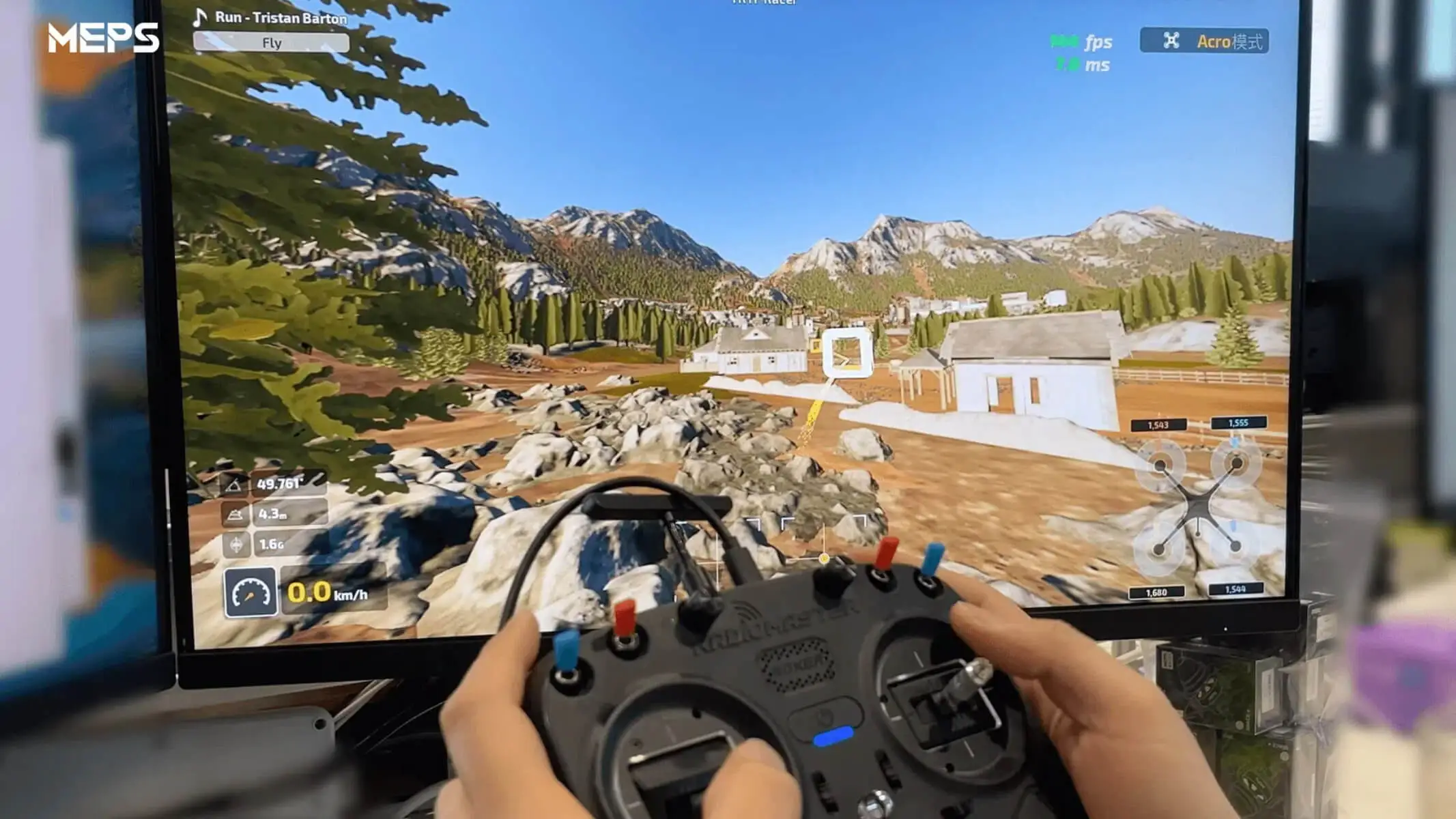
The distinction between “drone games” and “authentic flight simulators” has blurred dramatically by 2026, as modern physics-based simulations achieve 94-99.9% accuracy to real-world flying while simultaneously delivering engaging entertainment experiences. The convergence reflects a fundamental industry realization: immersive realism and genuine enjoyment are not mutually exclusive but rather synergistic. Games that authentically replicate drone physics create naturally compelling experiences where challenge emerges organically from technical mastery rather than artificial difficulty tuning.
This convergence has produced an ecosystem of experiences ranging from arcade-adjacent gaming with solid physics fundamentals to professional training-grade simulators indistinguishable from real flying—with the critical distinction that even “entertainment-focused” titles maintain physics fidelity sufficient to develop skills transferable to physical aircraft within 1-3 real flights.
The Physics Foundation: Why Authenticity Creates Immersion
The fundamental driver behind immersive drone experiences lies in accurate physics modeling. When a drone simulator correctly replicates gravitational acceleration, aerodynamic drag, battery voltage sag under variable current loads, wind turbulence, and prop wash effects, pilots naturally develop muscle memory and spatial intuition matching real aircraft behavior.
This physics accuracy operates at multiple precision levels. Basic simulators model the obvious: gravity pulling drones downward, thrust counteracting gravity, and turn dynamics. Advanced simulators replicate subtle effects that dramatically influence pilot feel: the Betaflight firmware’s actual PID control characteristics (including quirks and implementation details), motor thrust saturation behavior under extreme maneuvers, and I-term reset logic triggering at specific throttle thresholds.
The technical reality deserves emphasis: simulators cannot perfectly model real-world physics due to computational constraints and genuine unknowns. Drag calculations for drones prove “essentially impossible” to simulate with perfect accuracy because surface area changes depending on drone orientation and speed. Rather than pursuing impossible perfection, sophisticated simulators employ “shortcuts”—approximations that produce subjectively realistic feel even if mathematically imperfect. When these approximations prove well-calibrated against actual drone behavior, the simulator “feels right” to pilots despite technical imprecision.
Frame rate proves disproportionately significant for subjective authenticity. A simulator running at 60 frames-per-second produces noticeably “floatier” feel compared to 100+ fps operation, despite identical physics calculations. The performance difference reflects how frame rate directly impacts physics calculation frequency: at 60 Hz, gravity and drag calculations occur 60 times per second; at 144 Hz, calculations occur 144 times per second, producing smoother acceleration curves and more responsive flight dynamics. This counter-intuitive relationship—where computational power directly impacts subjective “realism”—explains why high-performance gaming PCs deliver notably superior immersion compared to modest hardware.
VelociDrone: The Professional Standard for Real-Feel Flying
VelociDrone ($22.65 PC) remains universally recognized as the gold standard for authentic flight feel, particularly among competitive pilots and professionals requiring maximum confidence that simulator training transfers directly to physical racing.
The physics implementation prioritizes low-latency responsiveness. Graphics quality remains deliberately basic, with minimal post-processing effects or shader complexity—design choices that enable exceptionally high frame rates (easily exceeding 240 fps on modest hardware) and minimal input-to-visual-feedback latency matching real DJI drone FPV transmission delays (~28-30 milliseconds).
Professional pilots consistently report that VelociDrone generates muscle memory producing virtually identical performance when transitioning to physical drones. Gate-hitting precision, racing line execution, and throttle control developed in VelociDrone transfer so directly that pilots demonstrate comparable competitive lap times within 1-3 real flights.
The simulator achieves this authenticity through meticulous calibration. Developers compared simulated quadcopter behavior directly against real-world flight data, identifying and correcting physics engine inaccuracies through iterative testing. Rather than assuming “correct” physics through mathematical formulas, the approach validates every behavior against actual flying characteristics.
However, this laser focus on physics authenticity creates trade-offs. The visual presentation appears dated compared to competitors; environments lack atmospheric richness and visual depth. For pilots accepting this aesthetic compromise in exchange for maximum flight authenticity, VelociDrone delivers unmatched confidence that simulator practice translates directly to competitive real-world flying.
Uncrashed: Balancing Realism with Cinematic Immersion
Uncrashed ($14.99 PC) occupies the “Goldilocks zone” between pure physics accuracy and visual storytelling. The simulator delivers solid physics (approximately 90-95% accuracy to real flight) while simultaneously providing environments detailed and visually rich enough to create genuinely immersive experiences.
The design philosophy reflects a different priority: “the most authentic freestyle flying experience available in an FPV simulator.” Rather than optimizing for competitive racing precision, Uncrashed prioritizes expansive environments enabling flowing maneuvers and cinematic flight paths. The diverse map library spans lush forests, urban landscapes, industrial areas, and fantastical environments—each crafted with meticulous environmental detail that enhances spatial immersion without sacrificing physics accuracy.
Critical for immersion, Uncrashed optimizes for smooth performance ensuring responsive controls during complex maneuvers. The physics engine produces predictable behavior enabling confident execution of aggressive techniques; pilots develop genuine aerial skills rather than fighting unintuitive control dynamics. User reviews consistently emphasize the “responsive and immersive” feel—mechanics that create natural engagement rather than frustration-driven gameplay.
Uncrashed’s multiplayer racing capabilities and workshop integration (enabling community-created tracks) generate sustained engagement beyond solo practice. The social dimensions—competing against pilots worldwide, discovering creative community-designed courses—create immersion extending beyond pure technical flying into community participation and shared achievement.
TRYP FPV: Visual Realism as Immersion Catalyst
TRYP FPV ($14.99 PC, 2022 release) pursues an alternative philosophy: maximizing visual environmental realism to create immersive spaces where authentic flight physics naturally become engaging rather than merely technically challenging.
The graphics quality reaches extraordinary fidelity—expansive maps with astonishing environmental detail, dynamic lighting conditions, and atmospheric effects that create visceral presence. When flying through realistically rendered environments, the visual stimulation compensates for inevitable physics approximations, creating subjective authenticity even where technical perfection doesn’t exist.
Recent updates (December 2025) reinforced this philosophy through enhanced immersion features: optional analog/digital effects simulating authentic FPV video noise and distortion, reverb effects modeling real audio propagation based on distance, and the legal ability to “explore the Eiffel Tower” reflecting real-world landmark environments.
The physics modifications in recent patches demonstrate developer commitment to authentic feel. Gravity simulation, momentum calculations, and sideslip effects received scrutiny to enhance realistic behavior; the updates specifically addressed physics accuracy relative to actual drone flight dynamics.
Performance demands remain substantial—high-end gaming PC hardware proves necessary for maximal visual settings—but pilots investing the equipment capability report that TRYP FPV “reaches a new level of immersion,” particularly for cinematic freestyle flying where environmental beauty enhances flight engagement.
FPV Logic: The Emerging Authenticity Standard
FPV Logic emerged in 2025 as an unexpected contender for authenticity leadership, with pilot comparisons suggesting physics accuracy rivaling VelociDrone while offering more balanced entertainment appeal.
Early adoption pilots report that FPV Logic’s gravity simulation, momentum handling, and sideslip calculations produce “the most authentic representation of real FPV flying” compared to established alternatives. The physics feel proves sufficiently distinct that pilots notice immediate differences when transitioning from VelociDrone or TRYP FPV to FPV Logic, suggesting genuinely differentiated physics implementation rather than marginal refinement of existing approaches.
As an emerging platform, FPV Logic benefits from contemporary development patterns incorporating latest physics optimization techniques and community feedback integration from established simulators’ maturation. This “fresh start” advantage allows FPV Logic to avoid legacy design decisions that constrain established simulators.
Real Drone Simulator (RDS): 3D-Scanned Real-World Authenticity
Real Drone Simulator pursues a unique differentiation: instead of stylized fantasy environments, RDS employs 3D-scanned real-world locations recreated with extraordinary precision.
The philosophy reflects professional training priorities. Rather than learning abstract flying in generic maps, pilots practice in literal reproductions of environments where they’ll eventually fly actual drones—eliminating environmental transition shock when moving from simulator to real-world operations.
The physics engine emphasizes accuracy matching specific drone configurations rather than generic quadcopters. Pilots input actual component specifications, and RDS calculates flight characteristics matching the custom build—enabling perfect muscle memory transfer when flying the same physical drone after simulator practice.
This specialization appeals particularly to professional operators (inspection services, construction site surveillance, emergency response) requiring training in specific real-world environments without travel costs or operational risks. The simulator functions less as entertainment and more as professional training tool where environment realism and physics accuracy directly impact operational readiness.
Liftoff XR: Mixed-Reality Immersion on Meta Quest 3
Liftoff: XR Drone (completely free on Meta Quest 3) introduces revolutionary immersion through mixed-reality technology rather than pure simulation.
Rather than traditional first-person cockpit perspectives, Liftoff XR scales drones to realistic proportions within users’ actual physical spaces. Through Quest 3’s spatial mapping technology, drones navigate around real furniture, cast realistic shadows on actual floors, and interact with genuine environmental geometry.
The immersion emerges not from graphics quality—Quest 3 native rendering lacks photorealism compared to high-end PC simulators—but from spatial authenticity. Flying a drone-scaled-aircraft through your living room creates visceral presence qualitatively different from monitor-based simulation. The physical space’s familiarity enhances spatial orientation development; pilots develop genuine environmental awareness rather than abstract 3D coordinate comprehension.
Physics remain respectable (approximately 94-97% accuracy), but immersion drive shifts from technical perfection to experiential authenticity. Users consistently report that spatial presence—”I’m flying a real drone in my room”—creates engagement exceeding more technically accurate PC simulators lacking spatial context.
Immersive Configuration: Maximizing Authentic Flight Feel
Regardless of specific simulator platform, experienced pilots employ consistent configuration practices that dramatically enhance authentic feel:
Controller Integration: Using actual radio controllers (Taranis, TBS Tango, Radiomaster TX16S) instead of game controllers produces substantially more realistic experience. Radio controller ergonomics, actual stick mechanical feedback, and physical orientation matching real aircraft control layouts—these elements create muscle memory transfer directly applicable to physical flying.
Graphics Settings for Physics Responsiveness: Counter-intuitively, reducing graphics quality improves physics feel. Disabling high-end visual effects, using lowest reasonable graphics settings, and maximizing frame rate ensures physics calculations execute at highest frequency. Pilots operating at 100+ fps consistently report superior authenticity compared to 60-fps operation despite seemingly reduced visual quality.
FOV and Fisheye Calibration: Configuring field-of-view to 120 degrees and maximizing fisheye distortion creates perspective matching actual FPV goggles. This calibration produces spatial scale matching real flight rather than distorted perspectives causing disorientation during transition to physical flying.
Rate Customization: Configuring stick rates (sensitivity) to match actual drone tuning ensures muscle memory aligns with real aircraft behavior. VelociDrone and most sophisticated simulators enable extensive rate customization; pilots matching simulator rates precisely to physical drone rates develop unambiguous skill transfer.
Minimize Graphics, Maximize Physics: The universal professional recommendation emphasizes that realistic flying requires physics-first optimization rather than visual quality. Setting graphics to lowest viable settings while maximizing frame rate produces superior immersion despite reduced visual fidelity—counterintuitive but consistently validated by expert pilots.
Psychological Authenticity: The “Fear Factor” in Real Flying
An often-overlooked dimension of authentic feel involves psychological factors impossible to replicate digitally. When flying real drones at high speeds, pilots experience genuine adrenaline responses and fear of equipment destruction that create psychological pressure absent in consequence-free simulator environments.
One experienced pilot articulated this distinction: “In the real world you’re terrified of hitting the ground. When you’re inverted and drop the throttle you freak the F out because you know you’re about to hit the ground. In the sim you’re just not scared.” This psychological difference means simulator-developed skills feel subjectively different when exposed to real consequences—initially more difficult despite technically identical physics.
However, this psychological gap narrows rapidly. Within 2-3 real flights, pilots’ brains adapt to actual consequences, and muscle memory from simulation transfers directly into real-world performance. The gap proves surmountable through brief real-world exposure rather than requiring extensive retraining.
2026 Trend: Convergence on Authentic-Realistic Experiences
By 2026, the market has consolidated around a common insight: immersion emerges through authenticity rather than despite it. The most engaging drone experiences combine physics accuracy sufficient for genuine skill transfer with environmental richness or technical sophistication that sustains engagement beyond pure training focus.
Emerging specialized platforms like FPV Battleground (real-world drone combat physics with mission-based gameplay) and ORQA FPV Skydive (detailed environments with sophisticated controller support) reflect this convergence—recognizing that authentic flight mechanics naturally generate compelling entertainment without requiring artificial gamification.
Conclusion: Authentic Flying as Entertainment
The fundamental achievement of 2026 drone gaming represents an inversion of traditional video game design. Rather than mechanics engineered for entertainment with physics approximated for convenience, the most immersive experiences result from prioritizing authentic physics and permitting natural entertainment emergence from technical mastery.
VelociDrone’s professional dominance despite dated graphics, Uncrashed’s sustained popularity despite overshadowing more visually spectacular competitors, and FPV Logic’s rapid adoption despite marketplace incumbents—these patterns validate that pilots naturally gravitate toward authentic flight feel regardless of visual presentation. Entertainment succeeds when mechanics accurately replicate real-world physics, enabling genuine skill development that creates internal satisfaction exceeding cosmetic spectacle.
By 2026, drone games that feel like real flight experiences aren’t niche technical training tools—they’re the mainstream category where authenticity and engagement have converged into a dominant competitive category that millions of Gen Z pilots actively choose over traditional gaming precisely because authentic flight physics create more satisfying experiences than arcade approximations.