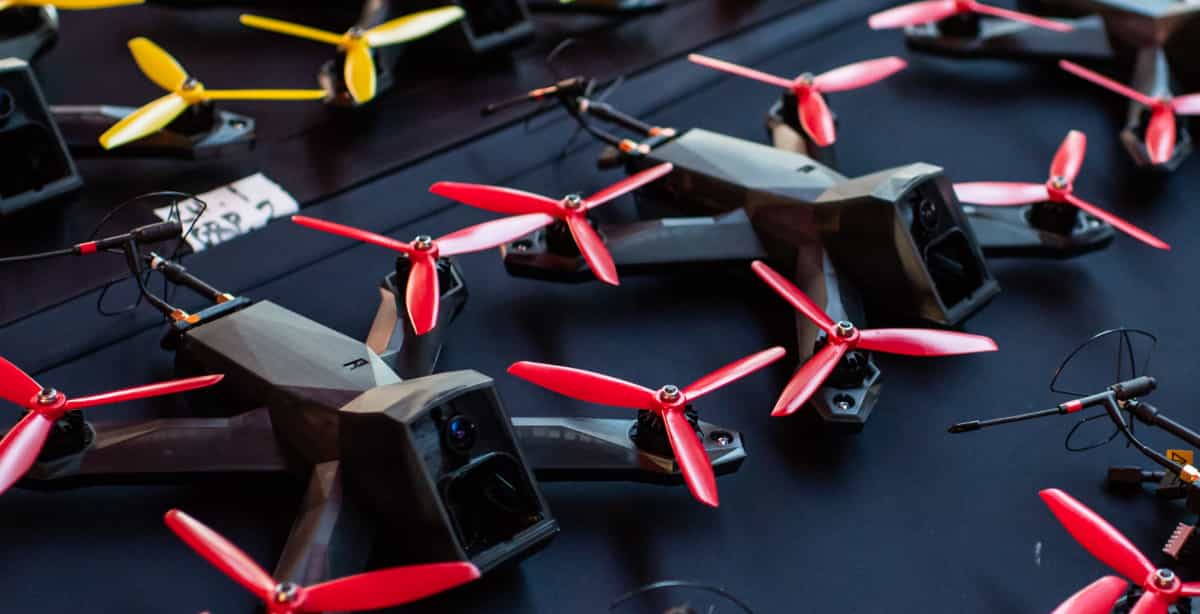
Drone racing represents one of the most remarkable esports phenomena of the 2020s: a competitive category that transcended niche hobbyist origins to achieve mainstream recognition, billion-dollar venture capital backing, and broadcast distribution across major television networks. By January 2026, the racing drone market has expanded to $2.02 billion annually with projections reaching $3.83 billion by 2030—growth rate of 17.4% compound annually. This explosion reflects not merely technological advancement but a fundamental shift in how younger generations conceptualize competitive sports entertainment. Unlike traditional esports confined to gaming consoles, drone racing seamlessly blends physical athleticism, real-time video game-like competition, and immersive first-person perspective into an experience no prior competitive category successfully executed.
The journey from 2015’s uncertain experimentation to 2026’s established competitive infrastructure reveals how visionary entrepreneurship, institutional validation, and demographic alignment converge to transform speculative ventures into sustainable industries.
The 2015 Founding: Converging Technologies and Entrepreneurial Vision
The Drone Racing League’s genesis emerged from circumstances that appeared inauspicious: Nicholas Horbaczewski, former Chief Revenue Officer of Tough Mudder obstacle course racing, identified drone technology as the nexus between gaming enthusiasm, technological sophistication, and spectator excitement. In 2015, FPV drones remained technical curiosities—specialized flying tools requiring specialized expertise, expensive equipment, and niche communities. Consumer drones (DJI Phantoms and Inspire models) dominated commercial imagination, but racing-specific machines barely existed.
Horbaczewski’s strategic insight recognized that esports audiences—numbering hundreds of millions globally—remained underserved by traditional sports. This generation of “tech-setters,” as DRL later branded them, demonstrated minimal enthusiasm for conventional athletics while exhibiting obsessive engagement with competitive video gaming. The critical innovation involved translating that gaming competence and aesthetic preferences into physical aircraft operating at 90+ mph, creating experiences neither traditional sports nor esports could independently deliver.
The league assembled foundational partnerships reflecting this vision. Ryan Gury, recruited as director of product, began designing and building DRL’s custom racing drones. Early investors included Miami Dolphins owner Stephen Ross, indicating sports industry recognition of drone racing’s potential. By September 2016—merely 8 months into operations—DRL announced $12 million Series A funding led by RSE Ventures and Lux Capital, with additional investment from MGM Television, CAA Ventures, and Hearst Ventures. This capital influx demonstrated that sophisticated investors believed drone racing could scale beyond initial novelty into genuine sport status.
Critically, September 2016 also marked global media partnership announcements: ESPN, Sky Sports, and ProSieben agreed to broadcast DRL content across 75+ countries. This was not minor regional coverage but commitment from tier-one international sports broadcasters—an extraordinary validation for a sport less than 12 months old. The implicit message: drone racing possessed intrinsic appeal sufficient to justify broadcast investment despite established sports’ dominance in media programming.
The 2016 Watershed: The World Drone Prix and $1 Million Prize Pools
The March 2016 World Drone Prix in Dubai represented the sport’s first transcendent cultural moment. With an unheard-of $1 million prize pool—comparable to established esports championships—the event attracted 150+ teams from 26 countries to compete for extraordinary financial stakes. Critically, the competition crowned a British teenager, Luke Bannister, as inaugural champion, awarding him a quarter-million-dollar first prize.
This moment crystallized drone racing’s generational appeal. Bannister’s victory at 15 years old demonstrated that mastery required youth’s reflexive hand-eye coordination and technological fluency rather than decades of physical conditioning. Unlike traditional motorsports where professional drivers emerged from established junior racing circuits spanning adolescence, drone racing compressed competitive development into years rather than decades. A talented teenager with simulator experience could genuinely compete for six-figure prizes—a democratization impossible in Formula One or NASCAR.
The financial magnitude shocked traditional sports observers. A quarter-million dollars for drone racing exceeded prize pools of established esports titles and rivaled successful YouTube content creator annual earnings. Media coverage propagated worldwide; drone racing transitioned from technical curiosity to legitimate competitive category with financial stakes rivaling professional athletics.
2017-2019: Professionalization and Broadcast Normalization
Following the Dubai watershed, DRL executed systematic professionalization. In February 2017, Allianz Insurance secured title sponsorship of the international championship series—a marker of institutional legitimacy. Insurance companies sponsor professional sports exclusively; Allianz’s commitment signaled institutional recognition that drone racing possessed sufficient permanence and audience reach to justify major brand association.
Technical innovations accelerated in parallel. Ryan Gury’s engineering team confronted extraordinary challenges: operating custom-built racing drones globally required navigating diverse electromagnetic spectrums across countries with incompatible RF regulations. Early competitions featured catastrophic failures—500+ drones destroyed annually when control links failed mid-race, often before massive in-person audiences and live television broadcasts. Gury’s team developed proprietary software-defined radio solutions, overcoming jamming and interference vulnerabilities that military organizations simultaneously grappled with.
The technical achievement became legendary: DRL RacerX achieved Guinness World Record status for fastest battery-powered RC quadcopter (163.5 mph in 2017). This wasn’t marketing hyperbole but genuine engineering accomplishment—the machine demonstrated physical feasibility of high-speed autonomous drone operation, validating the sport’s fundamental plausibility.
By 2019, DRL’s financial trajectory accelerated dramatically. The league raised $50 million Series C funding (with $26+ million committed before public announcement), bringing total capitalization to $80+ million by 2019. Investors included Liberty Media (Formula One ownership stake holder), indicating that sports investment professionals viewed drone racing as comparable asset class to traditional motorsports.
Media distribution expanded proportionally. By 2021-22, DRL claimed 260 million global digital views (23% year-over-year growth), reaching 320 million households across 170 markets—broadcast reach equivalent to established professional sports. Daily social media engagement averaged 3 million views, with 12 million followers across platforms. These metrics indicated that DRL had transcended novelty enthusiast appeal to achieve genuine mainstream recognition.
The 2021 Inflection: Algorand Partnership and Blockchain Integration
The September 2021 announcement of DRL’s five-year, $100 million partnership with Algorand blockchain represented a critical strategic pivoting point. This wasn’t peripheral sponsorship but fundamental integration: DRL would develop play-to-earn games where fans and pilots could earn cryptocurrency through competitive participation, with DRL’s IP and tokenomics anchored on Algorand infrastructure.
The timing appeared prescient: blockchain-based gaming peaked in cultural attention during 2021-2022, and DRL positioned itself at this intersection. Algorand’s commitment of $100 million represented one of esports’ largest blockchain integration investments, signaling Silicon Valley confidence in drone racing’s trajectory.
However, this partnership also represented DRL’s strategic vulnerability: sustainability of blockchain-based compensation depends on perpetual new participant inflows and price appreciation of underlying tokens. When cryptocurrency valuations collapsed in 2022-2023, the cryptocurrency-integrated gaming model faced credibility challenges. Nevertheless, the partnership demonstrated DRL’s willingness to embrace emerging technology categories rather than consolidate around conventional broadcast-only models.
The 2024 Pivot: Infinite Reality Acquisition and $250 Million Valuation
The April 2024 acquisition of DRL by Infinite Reality for $250 million represented the sport’s definitive mainstream validation. This wasn’t venture capital funding but strategic acquisition by a metaverse-focused technology holding company consolidating esports franchises, digital studios, and immersive entertainment properties.
The $250 million price established DRL’s peer valuation status alongside established esports organizations. The transaction elevated Infinite Reality’s overall valuation to $3.5 billion, signaling that DRL assets possessed strategic value comparable to multiplayer gaming franchises and professional esports teams.
Structurally, the acquisition revealed DRL’s institutional maturation. Nicholas Horbaczewski (founder/CEO) transitioned to Infinite Reality global president while retaining strategic influence. Rachel Jacobson, DRL president, assumed responsibility for Infinite Reality’s global business ventures—a succession pattern typical of successful mature enterprises rather than early-stage startups.
Critically, the acquisition preserved DRL’s operational structure through licensing arrangements with Super League Sports, which assumed permanent worldwide rights to produce DRL events and develop sponsorships. This separation of IP ownership (remaining with Infinite Reality) from operational management (delegated to Super League) reflected sophisticated corporate structuring typically reserved for Fortune 500 subsidiary relationships.
The Parallel Grassroots Revolution: MultiGP’s Decentralized Alternative
While DRL pursued professional centralization, MultiGP emerged as drone racing’s grassroots alternative—and arguably equally important to the sport’s rapid expansion. Founded by pilots explicitly “for pilots,” MultiGP organized competitive racing through decentralized local chapters rather than top-down professional franchises.
By 2026, MultiGP operates 385+ local chapters across 170+ countries, sanctioning 16,000+ races annually. The organizational structure prioritizes accessibility: membership remains free for local chapter participation, eliminating financial barriers that professional league structures inherently impose. Local chapters organize weekly or monthly events, creating perpetual competitive opportunities rather than seasonal championship calendars.
The platform sophistication deserves emphasis. MultiGP developed ZippyQ and RaceSync—proprietary race management systems enabling standardized scoring, qualification pathways, and leaderboard integration across geographically distributed chapters. This software infrastructure created genuinely transparent global competition: pilots in rural Pennsylvania can view their ranking relative to Tokyo’s or Sydney’s elite pilots through unified leaderboards, creating psychological connection to global competitive community despite physical isolation.
Most significantly, MultiGP embraced standardized competitive formats that dramatically reduced equipment investment requirements. The “Pro Spec” class mandates specific frame tolerances, propeller specifications, and battery capacity limits—ensuring competitive parity independent of equipment budget. A $400 custom-built Pro Spec drone fundamentally matches performance characteristics with $800 alternatives; only pilot skill and tuning precision differentiate outcomes.
This standardization democratized professional-tier competition in unprecedented fashion. Traditional motorsports enforce competitive parity through technical regulations but retain massive cost asymmetries (Formula One teams spend $500 million+ annually despite regulation). MultiGP’s standardization genuinely leveled competitive playing fields across economic strata, enabling subsistence-wage pilots to compete against well-funded veterans on equipment-neutral grounds.
The 2025 MultiGP International Open—described as “the biggest FPV drone racing event on Earth”—exemplified this democratization. The June 2025 gathering drew pilots worldwide to Muncie, Indiana (AMA Headquarters) for 15+ competitive formats spanning speed racing to freestyle showcases. Critically, entry remained affordable; the event welcomed “pilots of all skill levels” from “passionate newcomers to seasoned veterans,” rejecting the professional sport model’s inherent gatekeeping.
The Drone Champions League: International Mixed-Reality Innovation
The Drone Champions League, founded in 2016, pursued a distinct positioning: team-based international competition blending virtual and physical racing through “digital twin” technology. Rather than competing at generic artificial courses, DCL recreated iconic real-world landmarks—Paris’s Champs-Élysées (2017 debut with 150,000 spectators), the Great Wall of China, Brussels, Madrid—and digitally replicated these locations in virtual racing games.
This “phygital” approach created theatrical spectacle impossible in purely physical or purely digital competition. Live audiences watched pilots race through actual historic landmarks at 90+ mph, while simultaneous virtual competitions replicated identical courses in digital environments. The technological achievement required extraordinary precision: physical and virtual gate positioning matched exactly, enabling direct performance comparison between real and simulated racing.
By 2025, DCL restructured around a “three-cup format” (Falcon, Eagle, Hawk cups) comprising multiple matches with knockout progression, creating championship narrative arcs spanning seasons. This format resembled traditional sports’ multi-tournament structures rather than single-elimination championships, sustaining fan engagement across extended competition calendars.
The 2025 DCL season demonstrated the league’s matured production values. Races spanning “desert heat to alpine ice” traveled globally—a literal interpretation of Formula One’s continental circuit model, but executed at 1/100th the budget while reaching comparable audience sizes. This geographic diversity created marketing value: each race location generated local media interest and tourism appeal independent of drone racing’s inherent appeal.
The Autonomous Frontier: A2RL and AI Integration (2025-2026)
Perhaps most revolutionary, 2025 introduced the Autonomous Racing League (A2RL)—an entirely new competitive category where artificial intelligence systems compete against one another and human world champions in drone racing competitions. Founded by ASPIRE in Abu Dhabi, A2RL represents the convergence of drone racing sport with autonomous systems research.
The 2025 Abu Dhabi A2RL championship achieved a watershed technological moment: the “MonoRace” AI system defeated three human FPV world champion pilots in direct head-to-head competition. This wasn’t simulation but actual physical drone racing at speeds exceeding 100 km/h against identical conditions faced by human competitors.
The technical accomplishment deserves emphasis. MonoRace operated using only a monocular (single-camera) RGB sensor and IMU (inertial measurement unit)—deliberately constrained specifications forcing algorithm efficiency and real-world applicability. A neural network of merely 3×64 neurons (extraordinarily small by modern AI standards) running at 500 Hz on a 32-bit flight controller directly output motor commands. This wasn’t theoretical AI but practical embedded system operating within drone racing’s physical constraints.
The implications transcended sporting achievement. Autonomous racing serves as testbed for technologies applicable to logistics, inspection, emergency response, and future urban air mobility. Military organizations, recognizing that competitive environments accelerate technological development, demonstrated growing interest: Australia’s Defence Force has maintained world championship status “for six consecutive years,” and DroneShield (counter-drone technology company) sponsors the ADF team, indicating defense sector recognition of drone racing’s operational relevance.
The Generational Phenomenon: Gen Z Adoption and Demographic Positioning
Underlying drone racing’s institutional expansion lies a profound demographic reality: the sport has achieved unprecedented success targeting Gen Z audiences while traditional sports organizations struggle with generational engagement.
Approximately 90% of DRL’s global audience is under age 34, with overwhelming concentration among Gen Z (ages 14-21). This concentration reflects deliberate strategic positioning: DRL’s founder explicitly stated that “70% of DRL fans don’t engage with the big five sports” (American football, baseball, basketball, hockey, soccer), instead preferring “tech, video games, and content creation.”
This demographic positioning proves strategically brilliant. Generation Z demonstrates the highest rate of digital gaming adoption, with 38% of 14-21 year-olds identifying as esports fans—a proportion equaling professional football fandom. Drone racing satisfies the aesthetic preferences of this demographic: it’s technology-centric, visually spectacular through first-person video feeds, and integrates seamlessly with social media content distribution (TikTok, YouTube, Twitch).
DRL’s social media presence exemplifies this strategic focus. By 2022, DRL had accumulated 5 million TikTok followers—surpassing Major League Soccer and National Hockey League on the platform while approaching Major League Baseball audience size. This concentration on Gen Z-native platforms created cultural resonance impossible through traditional broadcast television. DRL’s 400% year-over-year TikTok growth rate during 2021-2022 reflected algorithmic amplification of content resonating with platform demographics.
Research validates this positioning. Deloitte’s 2023 Gen Z sports consumption study found that 67% of Gen Z and Millennial respondents expected professional sports consumption to be interactive by 2030, with 54% anticipating immersive experiences exceeding current standards. DRL essentially built its entire operational model around these anticipated future demands: interactive fan engagement through Twitch and social platforms, immersive first-person camera perspectives, and direct participation pathways enabling fans to transition from viewers to competitors through simulator training.
Broadcast Distribution and Mainstream Normalization
Drone racing achieved broadcast normalization at accelerating velocity. Initial agreements with ESPN, Sky Sports, and ProSieben (2016) established tier-one network commitment. By 2021-22, DRL had expanded to 20+ international broadcasters spanning NBC, FOX Sports Asia, Disney XD, and regional networks reaching 320 million households.
Critically, this expansion occurred during traditional broadcasting’s audience decline. Network sports viewership peaked in 2015-2016 and subsequently contracted as younger demographics migrated to streaming platforms. DRL’s simultaneous rise during this period indicated that the league captured “new” viewers rather than merely redistributing existing sports audiences.
The streaming integration proved particularly significant. DRL’s YouTube, Twitch, and Twitter presence enabled real-time fan engagement, community building, and content distribution beyond broadcast television’s geographic and scheduling constraints. This multi-platform approach reflected esports’ inherent distribution superiority: gaming franchises could simultaneously broadcast to millions across platforms, creating audience aggregation impossible through single network relationships.
The Professional Athlete Emergence
Perhaps most consequential for drone racing’s institutional legitimacy, the sport created genuine professional athlete opportunities with sustainable compensation. DRL professional pilots earn base contracts of $75,000-$100,000+ annually, with sponsorship and prize pool distributions frequently doubling total compensation. Top-tier pilots reported cumulative annual earnings exceeding $100,000, rivaling established esports professionals and exceeding most sports-adjacent professions.
The esports pathway innovation proved particularly significant. DRL SIM (the official esports simulator available on PlayStation, Xbox, Steam, and Epic Games) enabled pilots to compete in virtual tournaments with winners receiving direct invitations to professional leagues and sponsorship contracts. This created unprecedented democratization: a pilot without access to physical racing infrastructure could genuinely compete for professional contracts purely through simulator excellence.
Luke Bannister’s quarter-million-dollar 2016 World Drone Prix victory became merely the most famous example of drone racing’s extraordinary compensation relative to skill development timeline. A 15-year-old accumulated generational wealth in weeks—a trajectory impossible in traditional athletics where professional emergence requires 15-20 years of foundational training.
Current Market Landscape (2026)
By January 2026, drone racing leagues had consolidated around three primary competitive structures:
Professional: DRL operates as the premier global professional circuit, owned by Infinite Reality, reaching 100 million fans across 170 countries through 320 million household distribution. Operations delegated to Super League Sports under perpetual licensing arrangement.
Grassroots: MultiGP operates the world’s largest distributed racing community (385+ chapters, 16,000+ annual races), maintaining free membership and open participation across 170+ countries.
Mixed-Reality/Team-Based: Drone Champions League combines virtual and physical team competition across international locations, serving as bridge between grassroots and professional formats.
Autonomous: A2RL pioneer autonomous racing as emerging competitive category, with AI systems achieving parity with world champion human pilots by 2025.
The racing drone market reflects this institutional maturation: $2.02 billion in 2026 represents 17.4% year-over-year growth, with projections reaching $3.83 billion by 2030. North America dominates (mature esports ecosystem, major organizational bases), while Asia-Pacific emerges as fastest-growing region due to expanding electronics manufacturing and youth demographics.
Conclusion: From Novelty to Institutional Esport
The transition from Nicholas Horbaczewski’s 2015 founding vision to 2026’s established ecosystem represents esports’ most remarkable expansion trajectory. No competitive category transitioned from niche to $2 billion market valuation within one decade while simultaneously achieving broadcast normalization across major television networks and demographic dominance among primary target audience.
This success reflects convergence of technological feasibility (FPV drones became practically reliable only post-2015), demographic alignment (Gen Z preference for interactive technology-native sports), and institutional innovation (DRL’s hybrid physical-esports-metaverse architecture). Traditional sports struggled to capture Gen Z engagement precisely because their formats remained constrained by century-old physical realities. Drone racing, lacking such historical baggage, built from the ground up around digital-native audiences’ aesthetic and engagement preferences.
By 2030, when institutional forecasts project the racing drone market reaching $3.83 billion, drone racing appears positioned to rival established esports franchises in viewership, sponsorship value, and professional athlete compensation—validating Horbaczewski’s original vision of creating “the Formula One, NASCAR, and MotoGP of drone racing” for a generation that no longer watched traditional motorsports.